 A Gobble-Worthy Research Project
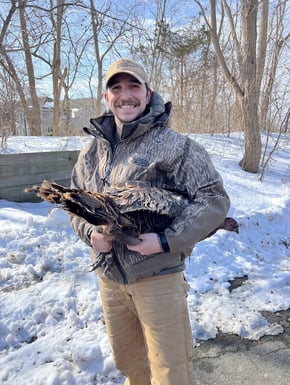
Dekka Ducote (2022 BACH AG) has been up close and personal with wild turkeys for the past year, and it has nothing to do with libation.
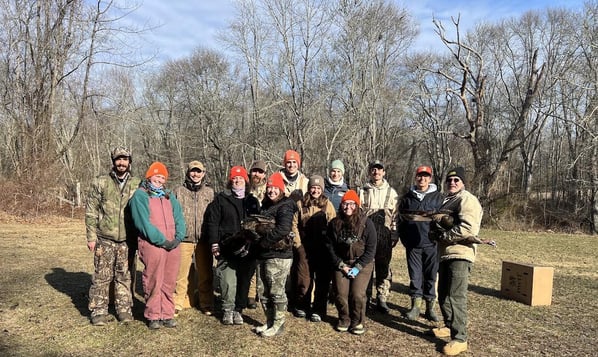
He joined fellow University of Rhode Island (URI) graduate students Chelsea Majone and Richard Mercer in spending a year studying New England’s most iconic bird, and they have some interesting insights to share in advance of Thanksgiving. While their study is ongoing, the group sees positive preliminary signs of turkey reproductive success in Rhode Island compared to other turkey-host states.
Getting to Know New England’s Wild Turkeys
Wild turkeys appear to be thriving there. Reintroduction efforts in the 1980s and ’90s were very successful in all five counties. It’s common now for people to see flocks in forests, fields, urban parks, and suburban neighborhoods.
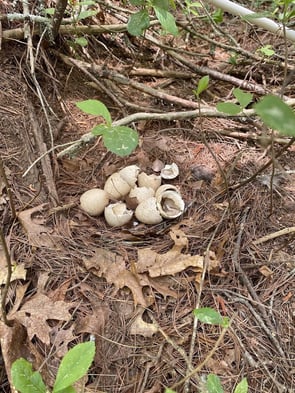
Over the course of the field season, Ducote and team followed and monitored tagged turkeys multiple times a week for almost six months. During that time, they got a feel for their favorite birds and others who like to cause us trouble. They found that turkeys in more rural landscapes are timid and like to hide and evade detection. In contrast, birds in urban areas are used to human activity. There have been countless times in urban areas where they were able to drive up and watch tagged birds hang out only feet from their truck. URI’s Department of Natural Resources Science launched a five-year study of the Eastern wild turkey last fall to track the bird’s health and population in Rhode Island, in partnership with the state’s Department of Environmental Management (DEM). Additionally, a three-year study is occurring in collaboration with Connecticut’s Department of Energy and Environmental Protection (CTDEEP).
From LSU Wetlands to New England Wildlife
By the early 1900s, wild turkeys no longer existed there. Reintroduction began in the 1970s and continued into the 1990s. Now, the species is established in Connecticut and Rhode Island, with wild turkeys found in all cities and towns across both states, except on Block Island and in Jamestown, Rhode Island. Ducote graduated from LSU’s Renewable Natural Resource Program and is a second-year master’s degree candidate in the Biological and Environmental Sciences program at URI.
At LSU, he worked closely with LSU's waterfowl research program under Dr. Kevin Ringelman, participating in field studies and conservation initiatives focused on Louisiana's wetland habitats. As an active member of LSU's Aquaculture and Fisheries Club, he trained alongside U.S. Fish and Wildlife Service biologists on technical field methods. This included practicing surgical suturing techniques to implant acoustic transmitters to track fish populations.
Congratulations to Ducote and his team at the University of Rhode Island!