LSU Alumnus Helps Create LSU-Branded Coffee
RocketCup is a small roastery and coffee company based in the village of Cattaraugus, New York. With their head roaster, Seth Orgel, a former French Horn professor at LSU, they’re on a mission to revitalize coffee. Like a fine wine or a robust whiskey, the process of coffee production is an art form in itself.
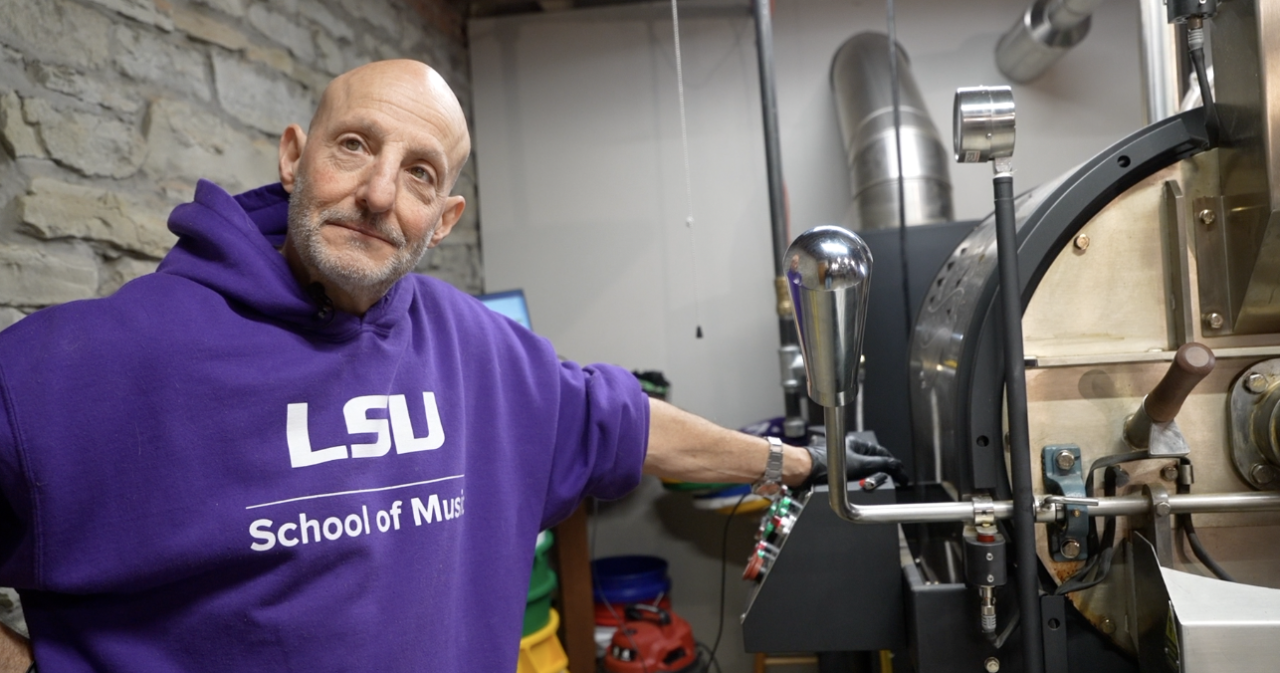
Orgel (2002 MAST M&DA) was a professor at LSU for 25 years before he joined RocketCup. A French Horn player, he retired from teaching in 2023 and is considered a faculty emeritus with the LSU School of Music.
“My wife got a job up here at St. Bonaventure University, and I had been promising her our whole marriage, think 30 years, that if she got a job that would take care of us, I’d follow her,” Orgel said. “I elected to retire and had to spend the next six months couch surfing after we sold our house, and my wife was up here.”
LSU Chamber Ensemble to Coffee Beans
Orgel first got into coffee while he was working with an LSU Chamber Ensemble that toured internationally. Orgel said the musicians were extremely into coffee, and one of them actually roasted his own beans, which piqued Orgel’s interest and became his new hobby.
“One of the guys started roasting his own, and then he infected me with the coffee bug,” Orgel said. “So about 20 years ago, I started roasting at home. So it’s always something I’ve enjoyed at home.”
Orgel first learned that RocketCup Coffees was looking for a roaster, so he got in contact with the co-founder and CEO Tom Cullen, a marketing professor at SBU, who hired him as head roaster.
Cullen works as the Director of the SBU innovation center. They opened their first cafe in Cattaragus, a village with around 1,000 people, and have helped with the growth in the economy. Since they opened, more than 10 other businesses have opened nearby, boosting the town’s economy.
“We just got a $10 million grant from the state because of the work we’re doing,” Cullen said. “And that’s really for the village to revitalize… we’re really on a mission to revitalize communities across the world.”
LSU Bayou Blend Specialty Coffee
RocketCup Coffee sells what is known as specialty coffee, which means that their coffees score higher than 80 on the Specialty Coffee Association scale. Coffee rated below this is considered commercial coffee. Scores take into account flavor, aroma, body, acidity, and balance.
“One of the keys of [coffee production] is people coming through and picking a lot of these beans by hand,” Cullen said. “They’re hand-picking coffee cherries at the perfect ripeness. But, other farms might just have machines that strip all the coffee cherries no matter what.”
The company ensures that the working conditions on the coffee farms are fair and that the bulk of profits stay in the coffee-growing countries, such as Honduras or Costa Rica. While RocketCup Coffee might be more expensive than their rivals, that is to fund the ethical acquisition of the coffee beans. Specialty coffee is considered more ethical than commercial coffee.
“In order to pay the laborers, we have to pay them a sensible rate in order to pick these beans at the same time and at the right time,” Cullen said. “Specialty coffee is actually considered the best and most sustainable way to support the whole coffee chain… it’s a few dollars more because people want the best-tasting beans.”
During his tenure as roaster, Orgel created the LSU Bayou Blend as part of RocketCup’s college coffee collection.
“We actually want to be the college coffee company,” Cullen said. “The target market is fans and alumni.”
Their first blend was the St. Bonaventure Blend known as Bonnie’s Blend. Cullen reached out to them because of his connections and their being local to the Cattaraugus area. Other college blends include the University of Tennessee Vols Blend, University of Florida Gator Grind, and Clemson “All-In” Blend.
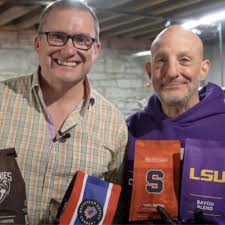 The Bayou Blend is a medium-dark roast with beans sourced from South American and Central American coffees, namely Honduras, Brazil, and Columbia. According to Orgel, the blend is heavy on Columbian coffee, helping with the smoothness of the roast.
“I lived [in Baton Rouge] for 25 years, and I tasted coffee at all the shops, and the only thing that would bug me is the acidic quality to some of the coffee,” Orgel said. “As far as I’m concerned, you shouldn’t have to drink bitter coffee, and your coffee shouldn’t need cream or sugar. So that’s what I roasted for.”